CBN Exchange Rate
The Central Bank of Nigeria (CBN) sets the official exchange rate used by banks, licensed Bureau de Change operators, and all regulated financial institutions for formal transactions. Today's CBN USD to Naira rate is ₦0 — the government-approved benchmark for imports, school fees abroad, business remittances, and other documented forex needs.
CBN Rate vs Black Market Rate: What's the Difference?
The CBN rate is typically ₦100–₦400 cheaper per dollar than the black market rate, but it requires documentation, bank processing (which can take 1–6 weeks), and proof of purpose. The black market gives instant access with no paperwork — at a premium.
Who Uses the CBN Rate
- Students paying international tuition fees through Nigerian banks.
- Importers opening Form M for overseas purchases.
- Businesses paying foreign invoices or repatriating profits.
- Travellers applying for Personal Travel Allowance (PTA) through their bank.
- Government agencies and multinationals for all official forex dealings.
What Moves the CBN Rate
Crude oil prices, Nigeria's foreign reserves, CBN Monetary Policy Rate (MPR) decisions, US Federal Reserve rate changes, and diaspora remittance inflows all influence how the naira trades at the official window. Aboki Dollar tracks these movements daily so you always have the latest verified CBN data.
CBN Exchange Rates Today
Last Updated: 00:00:00
Currency | CBN Exchange Rate |
|---|---|
 Dollar to Naira CBN Rate US Dollar | CBN USD to Naira ₦1,470 |
 GBP to Naira CBN Rate British Pound Sterling | CBN GBP to Naira ₦1,865 |
 Euro to Naira CBN Rate Euro | CBN EUR to Naira ₦1,610 |
 CAD to Naira CBN Rate Canadian Dollar | CBN CAD to Naira ₦1,040 |
 Swiss Franc to Naira CBN Rate Swiss Franc | CBN CHF to Naira ₦1,680 |
 JPY to Naira CBN Rate Japanese Yen | CBN JPY to Naira ₦10 |
 Yuan to Naira CBN Rate Chinese Yuan | CBN CNY to Naira ₦200 |
 Riyal to Naira CBN Rate Saudi Riyal | CBN SAR to Naira ₦390 |
 Rand to Naira CBN Rate South African Rand | CBN ZAR to Naira ₦80 |
 AUD to Naira CBN Rate Australian Dollar | CBN AUD to Naira ₦950 |
Currency | CBN Exchange Rate |
|---|---|
Dollar to Naira CBN Rate US Dollar | CBN USD to Naira ₦1,470 |
GBP to Naira CBN Rate British Pound Sterling | CBN GBP to Naira ₦1,865 |
Euro to Naira CBN Rate Euro | CBN EUR to Naira ₦1,610 |
CAD to Naira CBN Rate Canadian Dollar | CBN CAD to Naira ₦1,040 |
Swiss Franc to Naira CBN Rate Swiss Franc | CBN CHF to Naira ₦1,680 |
JPY to Naira CBN Rate Japanese Yen | CBN JPY to Naira ₦10 |
Yuan to Naira CBN Rate Chinese Yuan | CBN CNY to Naira ₦200 |
Riyal to Naira CBN Rate Saudi Riyal | CBN SAR to Naira ₦390 |
Rand to Naira CBN Rate South African Rand | CBN ZAR to Naira ₦80 |
AUD to Naira CBN Rate Australian Dollar | CBN AUD to Naira ₦950 |
Select Conversion Rate
Aboki Dollar CBN Exchange Rate
The Central Bank of Nigeria (CBN) sets the official exchange rates that govern all formal foreign currency transactions across the country. The CBN exchange rate dollar to naira today is the government-regulated benchmark used by commercial banks, licensed bureau de change operators, fintech companies, and all authorized foreign exchange dealers in Nigeria. Unlike the parallel market, which responds instantly to demand and supply shocks, the CBN rate is managed through deliberate monetary policy tools designed to maintain currency stability and support Nigeria's broader economic objectives.
Tracking the CBN rate is essential for anyone conducting formal financial transactions — from students paying international tuition to importers clearing goods at customs, from diaspora Nigerians sending remittances home to businesses paying foreign invoices. Aboki Dollar gives you daily, verified CBN rates in one easy-to-access platform so you're never working with outdated or inaccurate official rate data.
How the CBN Sets and Manages Official Exchange Rates
The Central Bank of Nigeria employs a combination of policy instruments to determine, defend, and adjust the official Naira exchange rate. Understanding these mechanisms helps you anticipate rate movements and plan your foreign currency transactions more strategically:
- Foreign exchange interventions: The CBN regularly sells dollars directly to commercial banks and authorized dealers from Nigeria's foreign reserves to stabilize the Naira and meet official demand.
- Monetary Policy Rate (MPR): The CBN's benchmark interest rate influences inflation, capital flows, and indirectly, the exchange rate. A higher MPR attracts foreign investment and supports the Naira.
- Cash Reserve Ratio (CRR): By adjusting how much banks must keep in reserve, the CBN influences how much liquidity banks have for forex operations.
- The Investors' & Exporters' (I&E) FX Window: This market-driven window allows willing buyers and sellers to transact at mutually agreed rates, with the CBN rate serving as a reference anchor.
- Foreign reserves management: Nigeria's gross external reserves (currently over $30 billion) back the CBN's ability to defend the Naira. Higher reserves give the bank more intervention capacity.
- Import restrictions: The CBN periodically bans certain import categories from accessing official forex, directing demand to the private sector and managing reserve spending.
- BDC licensing and oversight: The CBN regulates Bureau de Change operators who sell forex to retail customers at rates close to the official window, bridging the gap between banks and end users.
Who Must Use the CBN Official Exchange Rate
While the black market offers flexibility, many transactions are legally required to use the CBN rate through authorized channels. Here is who specifically depends on the official CBN rate:
- Commercial banks: All inter-bank forex transactions and customer FX sales must reference CBN-approved rates and go through the official market windows.
- Importers requiring Form M: Any importer opening a Form M (mandatory import finance document) with their bank must use the official CBN rate — customs duties are also calculated at this rate.
- Students applying for school fees PTA/BTA: Banks process Personal Travel Allowance (PTA) and Business Travel Allowance (BTA) at CBN rates for eligible applicants with supporting documents.
- Multinational companies: Foreign businesses operating in Nigeria are required to repatriate profits and conduct official transactions at CBN rates through their commercial bank accounts.
- Government agencies: All Federal and State government forex transactions — for imported equipment, technical services, or debt servicing — must use official CBN rates.
- International wire transfers: Banks processing outward wire transfers (for services, dividends, royalties, or loan repayments) use the official rate as per CBN guidelines.
- Receiving formal remittances: International money transfer operators (like Western Union, MoneyGram, and bank wire services) convert at rates pegged to the CBN official rate.
- Insurance companies and pension funds: These regulated institutions can only hold and transact foreign-denominated assets at CBN-approved rates.
Documents Required to Access Forex at CBN Rate Through Banks
One critical difference between the CBN official rate and the black market is documentation. Here is exactly what you need for the most common CBN-rate forex transactions:
- School fees / education (PTA): Valid university admission letter, acceptance letter or enrollment confirmation, completed school fees invoice on institution letterhead, and your international passport with valid student visa.
- Medical treatment abroad: Doctor's referral letter, medical center's estimate of treatment costs, hospital appointment letter or booking confirmation, and your international passport.
- Business imports (Form M): Proforma invoice from the foreign supplier, company CAC registration documents, tax clearance certificate, and a bank account in good standing for Form M opening.
- Business Travel Allowance (BTA): Business invitation letter from the foreign company, flight booking confirmation, hotel reservation, and a board resolution or management approval letter for corporate transactions.
- Dividend repatriation: CBN approval letter, audited financial statements, board resolution declaring the dividend, and proof of original foreign capital investment registration.
- Loan repayment / profit repatriation: Loan agreement documents registered with the CBN, evidence of the original inflow, and CBN certificate of capital importation (CCI).
- Personal remittances (PTA for travel): Valid flight ticket, international passport, hotel booking, and bank account with sufficient naira balance — capped at $4,000 quarterly per CBN guidelines.
CBN Rate vs Black Market Rate: A Clear-Cut Comparison
Understanding the differences between the official CBN rate and the black market rate is the single most important knowledge for any Nigerian dealing with foreign currency. Here is the full picture:
- Rate level: The CBN rate is typically ₦100–400 cheaper per dollar — meaning you pay less naira to buy the same dollar amount, making it more favorable when accessible.
- Who regulates it: CBN rate is set and regulated by the Central Bank of Nigeria. Black market rate is set purely by street-level supply and demand — no regulatory oversight.
- Documentation: CBN requires extensive paperwork matched to your specific purpose. Black market has zero documentation requirements.
- Processing time: CBN-channel transactions take 1–6 weeks depending on the purpose and bank. Black market exchanges complete in minutes.
- Legal status: CBN-channel transactions are fully legal and documented. Black market transactions are informal and operate outside regulatory oversight.
- Receipts and records: CBN transactions generate official receipts, bank debit confirmations, and SWIFT payment proofs. Black market transactions have no official paper trail.
- Availability: CBN forex is often rationed and not guaranteed even with full documentation. Black market currency is available immediately in virtually any amount.
- Best for: Use CBN for official, documented transactions where legality, receipts, and favorable rates matter. Use the black market for urgent personal needs where speed and no-documentation access are the priority.
Key Factors That Move the CBN Official Exchange Rate
The CBN rate is not static — it adjusts based on a combination of domestic and global economic forces. Tracking these factors on Aboki Dollar helps you anticipate favorable exchange windows:
- Crude oil prices and export earnings: Nigeria earns over 80% of its forex from oil exports. When oil prices are high, CBN receives more dollars, making interventions easier and the Naira stronger.
- Nigeria's foreign exchange reserves: Higher reserves allow the CBN to defend the Naira more aggressively. Falling reserves signal potential rate pressure even on the official market.
- CBN Monetary Policy Committee (MPC) decisions: Interest rate decisions by the MPC — particularly the Monetary Policy Rate (MPR) — directly influence inflation, capital flows, and the Naira's strength.
- US Federal Reserve interest rate decisions: Fed rate hikes strengthen the dollar globally, putting pressure on the Naira and potentially widening the gap between CBN and black market rates.
- Nigeria's trade balance: When Nigeria imports more than it exports (excluding oil), it needs more dollars than it earns, creating pressure on the Naira in both markets.
- Diaspora and foreign investment inflows: Higher dollar inflows from Nigerian diaspora remittances (estimated at $20+ billion annually) and foreign direct investment improve forex supply and stabilize the official rate.
- IMF/World Bank assessments: Nigeria's credit ratings and assessments by international bodies affect investor confidence, capital flows, and indirectly the CBN's ability to maintain its preferred rate corridors.
- Domestic inflation data: High inflation erodes Naira purchasing power, creating pressure on the CBN to either raise rates or intervene more aggressively to slow the depreciation.
The Investors' and Exporters' (I&E) FX Window Explained
One of the most important innovations in Nigeria's official forex market is the Investors' and Exporters' (I&E) FX Window, introduced by the CBN in 2017 and since expanded. Understanding how it works helps you use official channels more effectively:
- What it is: A transparent, market-driven CBN window where willing buyers and sellers transact at mutually agreed rates — different from the rigid official rate of earlier eras.
- Who participates: Foreign investors, Nigerian exporters, capital importers, diaspora investors, and licensed dealers can all participate in this window.
- Rate discovery: The I&E window uses a FMDQ (Financial Markets Dealers Quotation) trading platform where rates are set by actual transactions — making it the most market-reflective official rate in Nigeria.
- Repatriation guarantee: Foreign investors who bring capital through this window are guaranteed the ability to repatriate profits and principal at the prevailing I&E rate, reducing investment risk.
- Unification efforts: The CBN has periodically moved to unify the I&E rate with other segments of the official market to reduce the multi-rate distortions that encourage round-tripping and arbitrage.
- Impact on black market: When the I&E window operates efficiently with sufficient liquidity, it reduces pressure on the parallel market by providing a viable official alternative for more participants.
- Aboki Dollar tracks I&E rates: Our platform monitors transactions through official windows including the I&E market so you see the most complete official rate picture available.
How to Get the Best Value Using the CBN Rate
Accessing the official CBN rate effectively requires preparation, timing, and knowledge of the system. Here are proven strategies for maximizing value through official channels:
- Start your documentation early: Bank forex processing takes time — for school fees, start gathering documents 6–8 weeks before your payment deadline to avoid being forced into the black market at higher rates.
- Use your primary bank relationship: Banks prioritize forex allocation for customers with higher balances, longer banking history, and established relationships. Your account health matters for forex access.
- Check Aboki Dollar daily before applying: The CBN rate changes daily. Knowing the current rate helps you evaluate whether your bank's offered rate is fair or if you should push back.
- Request competitive quotes from multiple banks: Different banks within the CBN framework can offer slightly different spreads. Calling 2–3 banks before committing can save meaningful amounts on large transactions.
- Time applications around CBN intervention windows: The CBN typically releases dollars to banks in batches. If you detect a recent CBN intervention (dollar injection), apply immediately — forex is most available right after injection.
- Use licensed BDCs for personal needs: For smaller amounts like PTA or travel money, CBN-licensed Bureau de Change operators often provide faster access than commercial banks while still using official-reference rates.
- Keep all documentation organized: Banks regularly request additional documents mid-processing. Having everything — original invoices, admission letters, passports, and company documents — ready speeds up approval significantly.
- Escalate stalled applications: If your bank forex application stalls beyond 2 weeks with no clear update, escalate to the branch manager or the CBN Consumer Protection Department for resolution.
Why Aboki Dollar Is Nigeria's Most Trusted CBN Rate Tracker
Aboki Dollar was built to give Nigerians a single, reliable, no-confusion platform for tracking both official CBN rates and parallel market rates. Here is what sets us apart specifically for CBN rate tracking:
- Official source verification: Our CBN rates are sourced directly from Central Bank of Nigeria publications and FMDQ official market trading data — not estimated or extrapolated from secondary sources.
- Daily updates during CBN hours: We update our official rates every business day during CBN operating hours, so you always see the current rate and not yesterday's stale figure.
- All currencies in one place: USD, GBP, EUR, CHF, JPY, CNY, SAR, ZAR, XOF, XAF, WAUA — all CBN rates for all major currencies on a single platform without switching between sources.
- Side-by-side CBN vs parallel market comparison: Unlike other platforms that show only one rate, Aboki Dollar displays both the official CBN rate and the black market rate together, giving you the full market picture.
- Integrated currency converter: Use our currency converter to calculate exactly how much naira you'll need or receive for any foreign currency amount at the current official CBN rate.
- Historical rate charts: Track how the CBN rate has moved over days, weeks, and months to make informed decisions about when to transact — especially useful for large, planned forex purchases.
- Buying and selling rates displayed: We show you both the CBN buying rate (what authorized dealers pay for foreign currency) and selling rate (what you pay to buy foreign currency) for complete transaction transparency.
- No registration required: Access all CBN rate data instantly — no signup, no forms, no personal information required to view the information you need for financial planning.
- Mobile-optimized access: Our platform is fully optimized for smartphones so you can check official CBN rates on the go — at the bank, at the BDC, or before sending an international wire transfer.
Whether you are a student planning your international education budget, a business owner managing import costs, a professional receiving foreign salary payments, or simply someone who wants to understand what their naira is truly worth in international markets — checking the CBN rate on Aboki Dollar every day takes 30 seconds. It is the single most reliable way to protect your financial interests in Nigeria's complex and dynamic foreign exchange environment.
Latest Blog Post
See All
Nigeria Stock Market Leads Africa With 73% Dollar Return
Read more →
History of the US Dollar: Everything You Need to Know About the Dollar's Evolution
Read more →
The Nigerian Naira Redesign Explained: Objectives, Controversies & Economic Impact
Read more →
The Rise and Fall of the Nigerian Naira: The Untold Story Behind Nigeria's Currency Crisis
Read more →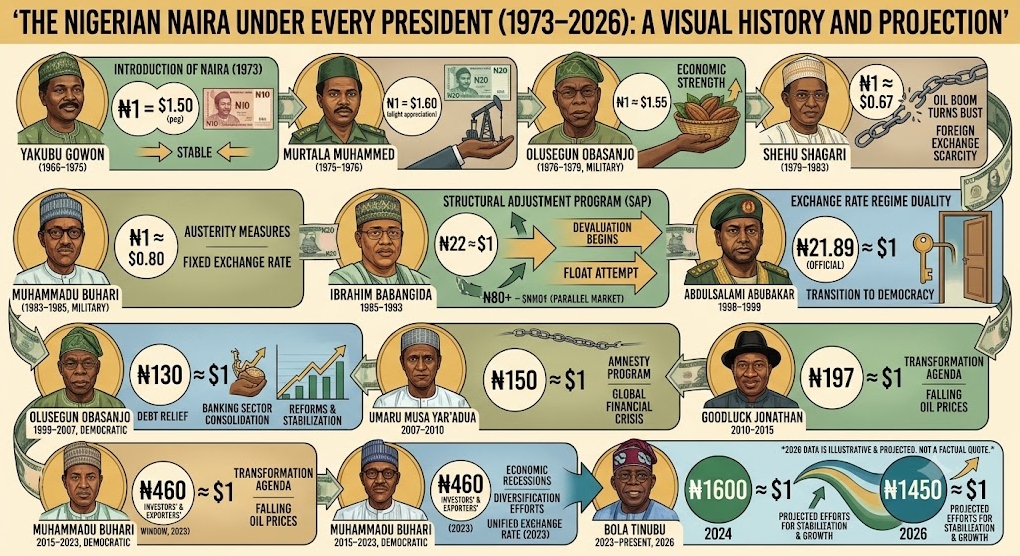
The Naira Under Every Nigerian President (1973–2026): A Complete History of Policies, Exchange Rates & Economic Impact
Read more →
The Complete History of the Nigerian Naira: Evolution, Currency Reforms & Economic Impact
Read more →
10 Interesting Facts About the Nigerian Naira You Probably Didn't Know
Read more →
CBN Overhauls FX Market: What the New Guidelines Mean for You in 2026
Read more →
Why More Nigerian Freelancers Prefer USD Payments
Read more →
Risks of Keeping All Your Savings in Naira in Nigeria
Read more →Comments on Aboki Dollar
No comments yet. Be the first to share your thoughts!