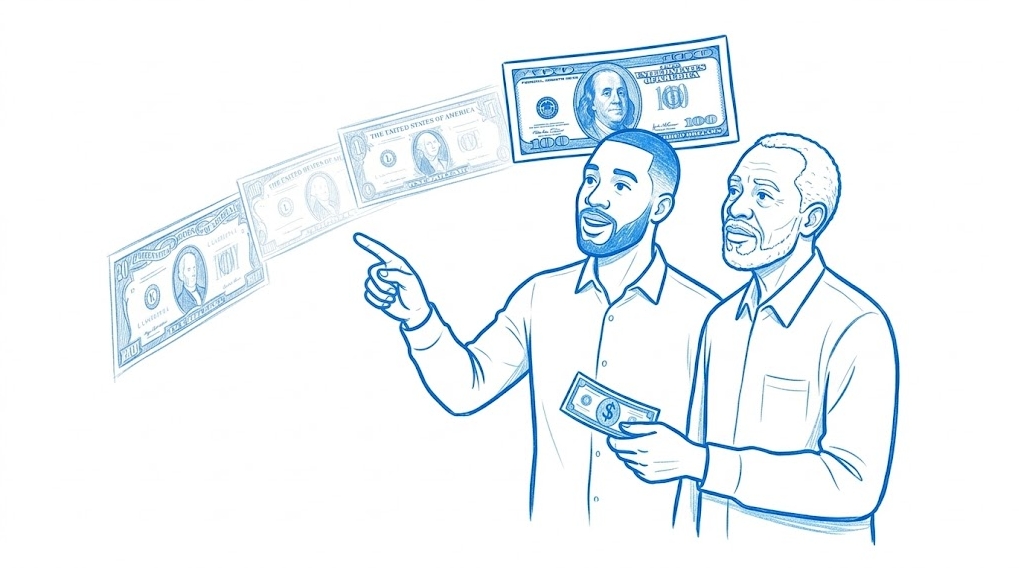
The U.S. dollar is one of the most important currencies in the world. It is used every day for buying goods, paying for international services, settling global trade, saving money, and measuring the value of other currencies. For Nigerians, the dollar is particularly important because changes in the dollar-to-naira exchange rate can affect imports, travel, international payments, business costs, and the prices of everyday goods.
But the U.S. dollar did not become a global currency overnight. Its history stretches back more than two centuries and includes the creation of the United States Mint, the development of the American banking system, periods of gold and silver standards, the creation of the Federal Reserve, the Great Depression, the Bretton Woods system, and the eventual transition to today's modern currency system.
Understanding the history of the dollar also helps explain why it has such a powerful influence on exchange rates around the world, including the Nigerian naira.
What Is the U.S. Dollar?
The U.S. dollar is the official currency of the United States. It is divided into 100 cents and is represented by the symbol "$" and the currency code USD.
Today, the dollar is issued in the form of Federal Reserve notes and coins produced by the U.S. government. Federal Reserve notes are the predominant form of U.S. paper currency in circulation. The Federal Reserve distributes currency through the banking system, while the U.S. Treasury's Bureau of Engraving and Printing produces the notes and the United States Mint produces coins.
The modern dollar is also a fiat currency. This means its value is not based on the ability to exchange each dollar for a fixed amount of gold or another physical commodity. Instead, its value is supported by the monetary and economic system of the United States, confidence in the currency, and its widespread use in domestic and international transactions.
That was not always the case. The dollar has gone through several major monetary systems throughout its history.
Where Did the Dollar Come From?
The story of the U.S. dollar actually began before the United States officially created its own national currency.
During the colonial period, people in North America used a mixture of foreign and locally produced coins. British pounds, German thalers, Spanish coins, and other forms of money circulated alongside colonial currencies.
Among these currencies, the Spanish milled dollar became particularly important. Its consistent silver content made it widely trusted and useful for trade.
According to the United States Mint's history of U.S. circulating coins, Spanish milled dollars were widely used during the colonial period, and people sometimes physically divided the coins into halves, quarters, eighths, and sixteenths to make smaller payments.
This history helps explain why the word "dollar" became familiar in the American colonies even before the United States established its own national monetary system.
How the Spanish Dollar Influenced the U.S. Dollar
The Spanish dollar played an important role in the development of America's monetary system because it was already familiar and widely accepted.
After the American Revolution, the new country faced a major problem: there was no single, standardized national currency system.
Under the Articles of Confederation, states could produce their own coins, while foreign coins continued to circulate. This created confusion because the same coin could have different values depending on where it was being used.
The United States therefore needed a standardized monetary system that could support trade across the new country.
The solution came with the creation of a national mint and the formal adoption of the dollar as the country's standard unit of money.
The Coinage Act of 1792
One of the most important events in the history of the U.S. dollar occurred on April 2, 1792, when Congress passed the Coinage Act.
The legislation established the first national mint of the United States and created a formal system of coins based on the dollar.
The U.S. Mint's historical record of the Coinage Act of 1792 shows that Congress established the dollar as the country's monetary unit and specified the metallic content of gold, silver, and copper coins.
The Act created denominations including:
- Gold eagles worth $10
- Half eagles worth $5
- Quarter eagles worth $2.50
- Silver dollars
- Half dollars
- Quarter dollars
- Dimes
- Half dimes
- Cents
- Half cents
The legislation also established a decimal system in which a dollar was divided into smaller units. A disme represented one-tenth of a dollar, a cent represented one-hundredth, and a mille represented one-thousandth.
This decimal structure became one of the defining characteristics of the American monetary system.
Why the Dollar Was Based on Silver and Gold
The early U.S. monetary system was based on precious metals, particularly silver and gold.
The Coinage Act specified the amount of precious metal that coins were supposed to contain. At the time, this was an important way of establishing confidence in money because the coins themselves contained valuable material.
The original system used a legal ratio of 15 units of silver to one unit of gold. However, the ratio did not always match market conditions.
This created problems. Some U.S. gold coins were undervalued relative to silver in international markets, encouraging people to export or melt them instead of using them as everyday money.
The U.S. Mint explains that silver dollars were also exported for international trade or stored as bullion during the early years of the American monetary system.
In other words, simply creating a national dollar did not immediately make the currency convenient or dominant. The United States had to spend decades developing its monetary and banking infrastructure.
The Dollar During the Early 1800s
During the early nineteenth century, the American financial system remained relatively fragmented.
The United States experimented with national banking institutions, including the First Bank of the United States and later the Second Bank of the United States.
However, the country did not yet have the modern Federal Reserve System that exists today.
Banknotes issued by different banks could circulate at different values, and financial instability remained a recurring problem.
This period is important because the history of the dollar is not simply the history of coins and banknotes. It is also the history of the institutions responsible for creating, distributing, regulating, and maintaining confidence in money.
The Civil War and the Greenback Dollar
The American Civil War created another major turning point.
The federal government needed enormous amounts of money to finance the war. In response, Congress authorized the issuance of government notes that became known as "greenbacks."
These notes were different from the earlier banknotes that had circulated throughout the country.
According to Federal Reserve History's account of the National Banking Acts, the Legal Tender Act of 1862 authorized $150 million in non-interest-bearing government notes. These became known as greenbacks.
The greenbacks were not convertible into gold or silver at a fixed rate in the way earlier metallic money had been. They represented an important development in the history of U.S. paper currency.
The Civil War also exposed another problem: the United States had a confusing mixture of banknotes issued by different institutions.
Different state-chartered banks issued their own notes, and these notes were not necessarily accepted at the same value everywhere.
This made nationwide commerce more complicated.
The National Banking Acts Create a More Uniform Currency
In 1863 and 1864, Congress passed the National Banking Acts.
These laws helped create a more standardized national banking system and introduced national bank notes.
The objective was partly to create a more uniform currency and partly to help finance the federal government during the Civil War.
The legislation also established the Office of the Comptroller of the Currency, which became responsible for supervising nationally chartered banks.
By the middle of the 1860s, the United States was moving toward a more centralized and standardized financial system.
However, serious banking problems had not disappeared.
Why the United States Created the Federal Reserve
Before the Federal Reserve existed, the United States experienced repeated banking panics.
When people became worried about banks, they could rush to withdraw their money. Banks could then face liquidity shortages, causing additional failures and financial stress.
The banking system also struggled to increase the supply of currency quickly enough during periods of financial pressure.
The Panic of 1907 was particularly important because it demonstrated the weakness of the existing financial system.
The crisis contributed to growing support for the creation of a central banking institution.
Congress eventually passed the Federal Reserve Act, and President Woodrow Wilson signed it into law on December 23, 1913.
The Federal Reserve's historical account of the Federal Reserve Act explains that the legislation followed years of debate about how to make the American financial system more stable.
The Birth of the Federal Reserve Note
The Federal Reserve Act created a new type of currency: the Federal Reserve note.
This was a major step toward the modern U.S. dollar.
Federal Reserve notes were designed to provide a more elastic currency supply, meaning the financial system could respond more effectively to changes in demand for cash and credit.
Federal Reserve notes were first issued in 1914.
Over time, they became increasingly important compared with the other forms of U.S. currency that had existed alongside them.
The Federal Reserve explains that Federal Reserve notes eventually became virtually all of the paper currency in circulation as other forms of currency were discontinued.
You can learn more about how U.S. currency evolved through the Federal Reserve's history of cash and currency services.
How the Dollar Became an International Currency
The dollar's international importance grew alongside the economic strength of the United States.
As the American economy expanded, international trade involving the United States increased. American banks and financial markets also became increasingly important.
By the 1920s, the dollar had become one of the world's leading currencies.
Federal Reserve History notes that by the mid-1920s, foreign governments and central banks held more of their foreign exchange reserves in dollars than in any other currency.
This was an important milestone because a currency becomes globally influential when other countries, businesses, and financial institutions are willing to hold and use it beyond the country where it is issued.
The dollar's international role would become even stronger after World War II.
The Great Depression and the Dollar
The Great Depression was another major turning point in U.S. monetary history.
The economic crisis that began in 1929 placed enormous pressure on banks, businesses, workers, and financial institutions.
The relationship between the dollar and gold also changed during this period.
In 1933, the U.S. government restricted private ownership of monetary gold. The following year, the Gold Reserve Act of 1934 transferred ownership of monetary gold to the U.S. Treasury and changed the official price of gold.
The Federal Reserve's history of the Gold Reserve Act explains how the legislation changed the relationship between the dollar, gold, and the U.S. government.
These changes were part of a broader transformation of the American monetary system.
World War II and the Rise of the Dollar
World War II dramatically changed the global economic balance.
Much of Europe and Asia had suffered enormous economic destruction, while the United States emerged from the war with a powerful industrial economy and significant financial resources.
This created conditions that helped the dollar become the foundation of the postwar international monetary system.
The Bretton Woods System
In July 1944, representatives from 44 countries met in Bretton Woods, New Hampshire, to design a new international monetary system.
The meeting resulted in the creation of the framework that became known as the Bretton Woods system.
The system was designed to provide greater monetary stability after the economic disruption of the Great Depression and World War II.
Under Bretton Woods, participating countries maintained exchange rates linked to the U.S. dollar, while the dollar was linked to gold at a fixed rate.
When the system became fully operational in 1958, the U.S. dollar was convertible into gold for foreign central banks at $35 per ounce.
The Federal Reserve's history of the Bretton Woods system explains how the dollar became the central currency for international payments under this arrangement.
This was a crucial moment in the history of the dollar because it formally connected the currency to the international monetary system.
Why the Dollar Became the World's Reserve Currency
A reserve currency is a currency that governments and central banks hold as part of their foreign exchange reserves.
The dollar became the world's leading reserve currency because several factors reinforced one another.
- The size and strength of the U.S. economy
- The importance of U.S. financial markets
- The scale of international trade involving the United States
- The stability and liquidity of dollar-denominated financial markets
- The dollar's central role under the Bretton Woods system
- The widespread use of dollars for international transactions
The U.S. Treasury has described the dollar as the world's primary reserve currency for more than six decades, with its reserve-currency role strongly supported by the Bretton Woods arrangement.
You can read the U.S. Treasury's historical perspective on the dollar's reserve-currency status for additional background.
The End of Dollar Convertibility to Gold
Although the Bretton Woods system was designed around the dollar's connection to gold, economic pressures eventually made the arrangement difficult to maintain.
As more dollars accumulated outside the United States, questions arose about whether the U.S. government had enough gold to maintain the promised conversion rate.
In August 1971, President Richard Nixon announced that the United States would suspend the dollar's convertibility into gold for foreign central banks.
This became known as the closing of the "gold window."
The decision effectively marked the beginning of the end of the Bretton Woods monetary system.
According to Federal Reserve History, Nixon's 1971 decision was driven by concerns including inflation and pressure on U.S. gold reserves.
The Dollar After Bretton Woods
After the collapse of Bretton Woods, the dollar was no longer fixed to gold at a specific official price.
The world moved toward a system in which exchange rates were increasingly determined by market forces.
This meant the value of the dollar could rise and fall against other currencies based on factors such as interest rates, inflation, economic growth, capital flows, monetary policy, and investor confidence.
This is the environment that largely exists today.
For someone in Nigeria, this is particularly important because the value of the dollar against the naira changes as market conditions change.
Our guide on Why the Dollar Rate Changes Every Day in Nigeria explains some of the factors that can cause exchange rates to move.
The Modern U.S. Dollar
Today, the U.S. dollar is a fiat currency rather than a currency directly redeemable for gold.
The Federal Reserve plays a central role in the U.S. monetary system. It conducts monetary policy, oversees important parts of the banking system, and works to support monetary and financial stability.
The dollar is also deeply integrated into the global financial system.
It is used in international trade, global investment, cross-border lending, foreign exchange transactions, commodities markets, and central-bank reserves.
This means an economic or monetary development in the United States can have effects far beyond American borders.
Why the History of the Dollar Matters to Nigerians
You might wonder why someone in Nigeria should care about events that happened more than 200 years ago in the United States.
The answer is simple: the dollar's historical development helps explain its enormous influence on Nigeria's economy and exchange rate.
Nigeria is heavily connected to international trade. Oil is priced internationally in dollars, many imports are purchased using dollars, and Nigerians receive foreign income and remittances in dollars.
When demand for dollars changes in Nigeria, the dollar-to-naira exchange rate can also change.
For example, when businesses need more dollars to pay overseas suppliers, demand for foreign currency can increase. When dollar inflows from exports, investments, or other sources increase, the supply side of the market can improve.
This relationship is one reason Nigerians pay close attention to the dollar-to-naira rate.
You can follow current movements through Aboki Dollar's 1 Dollar to Naira page.
Why the Dollar Is So Important to the Naira
The dollar is one of the most important reference currencies for Nigeria's foreign exchange market.
When Nigerians say that the naira is "weakening" against the dollar, they are describing a situation in which more naira are required to purchase one dollar.
When the naira strengthens against the dollar, fewer naira are required to buy one dollar.
However, the relationship is not simply about one currency becoming permanently "good" or "bad." Exchange rates are relative prices. The value of one currency is always being compared with another.
Our article on What Happens When the Naira Gets Stronger or Weaker? explores what these changes mean for Nigerians.
How the Dollar's History Connects to Today's Exchange Rates
The dollar's journey from a silver-based monetary unit to a global fiat currency helps explain why today's dollar exchange rates are determined differently from those of the eighteenth or nineteenth centuries.
In the early United States, the value of a dollar was closely connected to the quantity and composition of precious metals contained in coins.
Later, the dollar became connected to gold through different versions of the gold standard.
Under Bretton Woods, other currencies were linked to the dollar and the dollar was linked to gold.
Today, the dollar's value is determined by market forces and the broader economic and financial system.
This evolution is important because it shows that money is not static. Monetary systems change as economies, governments, financial institutions, and international trade change.
Why Dollar Demand Matters in Nigeria
The dollar's global role creates significant demand for the currency in Nigeria.
Importers may need dollars to pay foreign suppliers. Students may need dollars for education-related expenses abroad. Travelers may need foreign currency for international trips. Businesses may need dollars for software subscriptions, equipment, services, or overseas transactions.
Freelancers and remote workers may also receive payments in dollars from international clients.
All of these activities create connections between the dollar and the Nigerian economy.
That is why understanding the dollar can be useful even if you live thousands of kilometres away from the United States.
Why the Dollar Rate Can Change So Quickly
The modern foreign exchange market operates continuously across different financial centres around the world.
The price of a currency can respond to new economic information, central-bank decisions, geopolitical developments, interest-rate expectations, changes in commodity prices, and shifts in investor confidence.
In Nigeria, domestic supply and demand for foreign currency also matter.
This is why the dollar-to-naira exchange rate can change from one day to another rather than remaining fixed.
For a deeper explanation, read What Determines the Dollar to Naira Rate in Nigeria?
Does the Dollar Always Become Stronger?
No.
The dollar can strengthen or weaken against other currencies.
Its exchange rate depends on the currency it is being compared with and the economic conditions affecting both countries.
For example, the dollar can rise against the naira while simultaneously falling against another major currency. Exchange rates are relative, so there is no single global price for the dollar.
In Nigeria, however, movements in the dollar-to-naira rate are particularly important because of the country's dependence on international trade and foreign currency transactions.
The Dollar and Inflation
Inflation can influence exchange rates because persistent differences in inflation between countries can affect the purchasing power of their currencies.
For Nigerians, this relationship is especially relevant because a weaker naira can increase the naira cost of imported goods and services.
That does not mean every price automatically moves by the same percentage as the dollar. Businesses have different costs, margins, supply chains, and pricing strategies.
Nevertheless, exchange-rate movements can contribute to price pressures throughout an economy.
Read How Inflation Affects the Dollar to Naira Exchange Rate for a closer look at this relationship.
How the Dollar Became More Than Just American Money
One of the most remarkable aspects of the dollar's history is that it developed from a national unit of account into a currency with enormous international importance.
Countries around the world use dollars in international transactions. Companies may invoice products in dollars even when neither the buyer nor seller is American. Central banks may hold dollar-denominated assets as reserves. Investors may use U.S. financial markets to store or deploy capital.
This widespread usage creates a powerful network effect.
The more people and institutions use a currency, the more useful it can become to other participants in the global economy.
The Dollar's Role in International Trade
International trade requires businesses to agree on prices and settle payments across different currencies.
Using a widely accepted currency can simplify this process.
The dollar has become one of the most important currencies for international commerce, which means movements in its value can affect countries that have little direct connection with the United States.
This is one reason oil prices, international shipping costs, commodities, imports, and other global transactions can have implications for economies such as Nigeria's.
What the Dollar's History Teaches Us About Currency
The history of the U.S. dollar provides several important lessons about money.
First, currencies depend heavily on confidence. A currency must be accepted by people and institutions for it to function effectively.
Second, monetary systems can change. The United States moved from precious-metal-based money through different banking and gold-standard arrangements to today's fiat currency system.
Third, economic power matters. The growth of the U.S. economy and financial markets played an important role in the dollar's rise to international prominence.
Finally, a currency's international importance can influence countries far beyond its borders.
Frequently Asked Questions About the History of the U.S. Dollar
When was the U.S. dollar officially created?
The dollar was formally established as the standard monetary unit of the United States through the Coinage Act of 1792, which also established the first national mint.
Where did the U.S. dollar get its name?
The American dollar was influenced by the Spanish milled dollar, a widely circulated silver coin in the Americas. The term "dollar" itself has European historical roots and became widely used in North America before the United States established its national currency.
Was the U.S. dollar originally backed by gold?
The early U.S. monetary system used both gold and silver coins with specified metallic content. The relationship between the dollar and gold changed over time as the American monetary system evolved.
When was the Federal Reserve created?
The Federal Reserve System was established by the Federal Reserve Act of 1913. The Federal Reserve Banks opened for business in 1914.
When did the dollar become the world's leading reserve currency?
The dollar's international importance grew significantly during the first half of the twentieth century. By the mid-1920s, foreign governments and central banks were already holding more foreign exchange reserves in dollars than in any other currency. Its role became even more important after World War II and under the Bretton Woods system.
Is the dollar still backed by gold?
No. The modern U.S. dollar is a fiat currency and is not redeemable for a fixed quantity of gold. President Richard Nixon ended the dollar's convertibility into gold for foreign central banks in 1971.
Why does the U.S. dollar matter so much in Nigeria?
The dollar plays an important role in international trade, imports, oil markets, remittances, foreign investment, and cross-border payments. As a result, changes in the dollar-to-naira exchange rate can affect businesses and consumers in Nigeria.
Final Thoughts
The history of the U.S. dollar is a story of constant change.
It began in an environment where foreign coins such as the Spanish milled dollar were already widely used. The United States then created its own national mint and formally adopted the dollar through the Coinage Act of 1792.
Over the following centuries, the country moved through periods of precious-metal money, paper currency experiments, national banking reforms, gold-standard arrangements, and eventually the creation of the Federal Reserve.
After World War II, the dollar became the centre of the Bretton Woods international monetary system. When that system ended and the dollar's convertibility into gold was suspended in 1971, the currency entered the modern era of floating exchange rates and fiat money.
Today, the dollar remains one of the most important currencies in the global economy. Its history helps explain why movements in the dollar can have consequences for countries around the world, including Nigeria.
For Nigerians, following the history of the dollar is therefore more than an academic exercise. It provides useful context for understanding why the dollar-to-naira exchange rate matters, why the rate changes, and why developments in the U.S. economy and financial system can eventually affect prices and financial decisions in Nigeria.
To keep track of current exchange-rate movements, visit Aboki Dollar's Dollar to Naira Black Market Rate page or check the CBN Exchange Rate page.
If you have questions about the dollar, exchange rates, or how currency changes affect Nigerians, you can also comment here and join the discussion on the Aboki Dollar Forum.
Sources and Further Reading
- United States Mint: History of U.S. Circulating Coins
- United States Mint: Coinage Act of 1792
- Federal Reserve History: National Banking Acts
- Federal Reserve History: Overview of the Federal Reserve
- Federal Reserve History: Creation of the Bretton Woods System
- Federal Reserve History: Nixon Ends Dollar Convertibility to Gold
- U.S. Treasury: Historical Perspective on the Reserve Currency Status of the U.S. Dollar